August 2026
Volume 19 Issue 10



Those of you who work in ADA employment accommodations or who have been following recent EEOC enforcement activity might be noticing a trend: the use of third-party vendors for employment accommodations seems to be on the rise and federal agencies are taking notice.
In recent years, our technical assistance callers are reporting more and more that their employers are working with third-party vendors to handle the ADA accommodation process. Some vendors only assist with a portion of the process, such as handling medical documentation, while others handle everything from start to finish. A regional attorney for EEOC’s Atlanta District has stated that this method can be “inherently problematic”; and the Job Accommodation Network (JAN) acknowledges that even though there might be some benefits to using third-parties, such as more consistency or time given to requests, employers should be mindful of the risks related to handing over their accommodation process altogether.
Based on what our Center has seen from recent EEOC cases, JAN guidance and technical assistance calls, here are some common concerns employers should be aware of when considering third-parties:
Learn More:

OFCCP Ends Federal Self-Identification Disability Inquiries
On August 21, 2026, the Office of Federal Contract Compliance Programs (OFCCP) published a final rule to revise its Section 503 regulations under the Rehabilitation Act. The rule, which is set to take effect on September 21, 2026, will eliminate the collection of disability status information from applicants and employees of federal contractors for affirmative action purposes. It also retires the Office of Management and Budget (OMB) approved form (Form CC-305) that federal contractors were required to use to invite self-identification. Learn more about the upcoming changes to disability self-identification requirements for federal contractors.

The ADA Generation: Still Fighting for Disability Rights
The "ADA generation" describes people who were born after the Americans with Disabilities Act of 1990 was passed and have never lived at a time without wide-ranging disability rights protections under U.S. law. Many of these individuals are coming of age and are now taking up the fight to ensure that the hard-won rights of people with disabilities are protected. Learn more about how two siblings, Cody and Kaleigh Brendle, are continuing the fight for disability rights.

FCC: Making Closed Caption Settings Easier to Find
If you purchase a television, cable or satellite set-top box, smartphone, tablet, or computer manufactured on or after August 17, 2026, you should be able to locate caption settings more easily without searching through multiple menus. Thanks to a new Federal Communications Commission (FCC) requirement under the Twenty-First Century Communications and Video Accessibility Act (CVAA), people who rely on captions should have easier access to television and video programming. Learn more about how the new FCC rule has made closed caption settings easier to find.

Law to Protect People with Disabilities from Financial Exploitation
A new law aims to protect seniors and adults with disabilities from financial exploitation by empowering banks, credit unions and investment firms to intervene when suspicious activity is detected on a vulnerable adult's account. Under the law, financial institutions will be empowered to disclose suspicions of financial exploitation to trusted contacts, co-owners, beneficiaries, or known family members of the account holder, and will be able to place a temporary hold on transactions when exploitation is reasonably suspected. The law will expand the list of mandated reporters under the Adult Protective Services Act to include investment advisers, securities dealers and financial institution employees with direct access to eligible adult clients' accounts.
Learn more: Lightford champions law to protect seniors and adults with disabilities from financial exploitation
Pilot Program to Make Accessible Parking Placards Easier to Obtain
Illinois Secretary of State Giannoulias announced that he has launched a pilot program to make parking disability placards easier to obtain. The program follows a new law that allows families caring for children and adults with disabilities to obtain accessible parking placards more easily. The law allows the Secretary of State's office to issue meter-exempt placards to legal guardians who transport those with disabilities who can't drive themselves. To support the new law and for better customer service, the Secretary of State's office is expanding disability placard services to 14 more DMV facilities in Illinois.
Learn more: Giannoulias launches pilot program to make handicap placards easier to obtain in Illinois
Lawmakers Want Answers on Medicaid Coverage Denials
State lawmakers are demanding answers following Indiana I-Team’s investigation into families with disabled children who were kicked off Medicaid. Parents of kids with disabilities rely heavily on Medicaid and its Home and Community Based Services waivers. These programs help fund critical therapies like speech, occupational, physical and behavioral. FSSA has launched a new assessment tool which is leading to more Medicaid waiver denials. Under the old assessment system, FSSA’s denial rate for Medicaid waivers was .02% and it’s currently at 6%, according to FSSA.
Learn more: 'Too much, too fast': Lawmakers want answers on Medicaid coverage denials
Tobacco Prevention Coalition: Treatment Should Be Accessible to All
According to the Tobacco Prevention Coalition (TPC), tobacco use continues to disproportionately affect Hoosiers living with disabilities. Barriers such as transportation, healthcare costs, inaccessible facilities and equipment, and communication challenges can make accessing tobacco treatment more difficult.
Learn more: Tobacco treatment should be accessible to everyone
Prisons Paid Millions over Inmate Deaths & Disability Discrimination
The Michigan Department of Corrections (MDOC) paid out $7 million in legal judgments and settlements in 2025, more than double the prior year, according to a mandated report recently filed with the state Legislature. Most of those payouts stemmed from three cases: a $2.3 million settlement with a former MDOC employee who alleged disability discrimination, along with two judgments of $2.5 million and $1.2 million related to a series of 2022 stabbings at Macomb County Correctional Facility that resulted in two inmate deaths and injuries to another, according to a new state report. Overall, the state government paid out $38 million in court judgments and settlements in the 2025 fiscal year, a 62% reduction from the prior fiscal year
Learn more: Michigan prisons paid millions over inmate deaths, disability discrimination
A Renewed Push to Ban Seclusion & Reduce Restraint in Schools
Michigan schools are restraining or secluding students nearly 18,000 times a year— many of them children with disabilities. That’s despite an almost 10-year-old law aimed at reducing instances where students are secluded or restrained. Advocates say teachers and staff need to be trained on how trauma affects learning and districts need plans to reduce restraint. A special education administrator says training is already happening, raising doubts if more legislation is needed.
Learn more: A renewed push to ban seclusion, reduce restraint in Michigan schools
Cancer Patient Fired During Treatment Wins $115K
Brainerd-based ice house company Glacier has been ordered to pay $115,000 after firing an employee who took leave for cancer treatment. The Minnesota Department of Human Rights (MDHR) found the company discriminated against and retaliated against the employee because of their disability. As part of the settlement, the company must also update its policies and submit reports twice a year for a three-year period.
Learn more: Glacier Ice House in Brainerd fined $115K after firing worker, violating disability laws
New Tool to Help Prepare For 2027 Federal Work Requirements
The Minnesota Department of Human Services (MDHS) has launched a new online tool to help Medical Assistance enrollees find out whether they will need to meet new federal work requirements taking effect January 1, 2027. Enrollees can access the renewal lookup tool through August 31. If records indicate an enrollee must meet the new work requirement, the tool will ask whether they expect to qualify for an exemption or complete a qualifying activity. After August 31, enrollees can still report exemptions and qualifying activities by calling or visiting their county, Tribe or the MDHS.
Learn more: Minnesota launches tool to help Medical Assistance enrollees prepare for 2027 federal work requirements
Ohio Students With a Disability On the Rise
The number of Ohio students with a disability is rising compared to before the pandemic, according to Ohio Department of Education and Workforce (ODEW) data analyzed by the Dayton Daily News. This is creating financial challenges for districts and headaches for parents and children who have not received needed care. Districts also told the Dayton Daily News that in addition to more kids requiring IEPs, more students are requiring intervention and a 504 plan.
Learn more: More Ohio students have a disability: Schools, families face challenges
State Fair Highlights Safe Sensory Cooking for Disabled Visitors
The Ohio State Fair hosted a cooking demonstration for those with diverse abilities last week, showing visitors how to make safe sensory snacks with help from the Ohio Department of Developmental Disabilities. The Ohio Agricultural Center invited a number of people with disabilities to attend the cooking Demo on July 30, 2026, showing them how to make nutritious and easy snacks with Ohio-made products.
Learn more: Ohio State Fair highlights safe sensory cooking for disabled visitors
Wisconsin Gets $10.5M to Train More Special Education Teachers
Wisconsin has been awarded a five-year, $10.5 million federal grant to strengthen the state's special education workforce and help more special education teachers build careers in Wisconsin schools. The U.S. Department of Education awarded the grant to the Wisconsin Department of Public Instruction as part of its State Personnel Development Grant Program. The funding will support the Special Education Teacher Apprenticeship and Induction Retention System in Wisconsin, a statewide initiative focused on recruiting, preparing and retaining special educators.
Learn more: Wisconsin wins $10.5M federal grant to keep special education teachers in classrooms
A Wheelchair Ride Across Wisconsin Calls Attention to Medicaid Cuts
After a 125-mile trip on his powered wheelchair, Carl Schulze rolled up just before noon Thursday to the Wisconsin Capitol. The resident of Fox Crossing made the journey to make a point: How Medicaid has helped him and thousands of other Wisconsin residents with disabilities — and how that help is being threatened.
Learn more: A wheelchair ride across Wisconsin calls attention to Medicaid cuts

The Ultimate Back-To-School Guide for Families of Children with Disabilities
Back-to-school checklists are often tailored towards the needs and experiences of non-disabled children, leaving families of children with disabilities to figure out the rest on their own. Check out this collection of resources and information from the Arc to prepare parents and their children with disabilities for a new school year.

New Report: Area Agencies on Aging
National Senior Citizens Day falls on August 21. New data from the 2025 National Area Agencies on Aging (AAA) Survey shows the vital role these organizations play and the way they have adapted their services to meet the complex needs of a growing older adult population. Check out the report to learn about the trends and priorities of Area Agencies on Aging.

Preparing for Severe Weather
Recently, the Great Lakes region has been experiencing severe thunderstorms and other weather events. Learn how to prepare for severe weather with this helpful resource from Disability Belongs. Also check out our recent Q&A webinar, Ask an ADA Professional RE: Emergency Management and Preparedness.
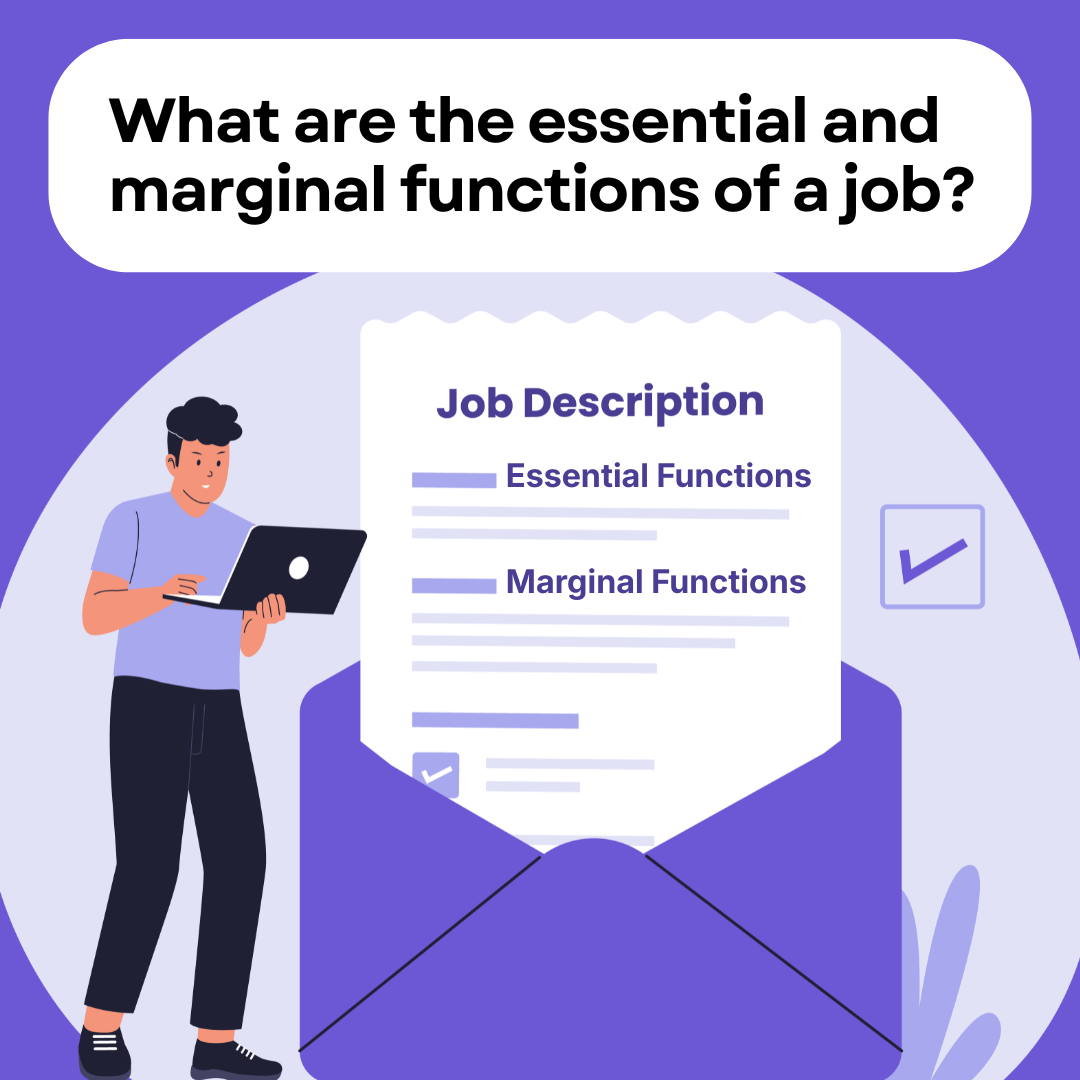
Answer: Under Title I of the ADA, essential functions are core parts of a job that every person in that role must be able to do, regardless of their disability. A reasonable accommodation may be needed for an employee to perform the function, but employers are generally not required to eliminate or reassign an essential function as an accommodation. However, employers can be required to eliminate or reassign non-essential marginal functions as an accommodation, when reasonable. The employer can also swap marginal functions amongst employees as a form of reasonable accommodation if an employee with a disability is able to perform some marginal functions but not others.
In order to determine if eliminating or reassigning a certain job function would be reasonable, the employer must determine if the function is essential or marginal. This will be a case-by-case analysis, but some factors to consider might include:
It is important for employers and employees to understand that just because a duty is listed in a job description or is called "essential" by an employer does not necessarily mean it is an essential function according to the ADA. Job descriptions can be used to support an essential function claim, however, it is not the only thing to consider. Employers who call a duty "essential" to avoid making reasonable accommodations can be found in violation of the ADA if they lack supporting evidence to back up their claim.
Resource(s):
Learn more by visiting our ADA Frequently Asked Questions.

EEOC v. Paycom Payroll, LLC (Paycom)
The suit said that an employee with a severe allergy repeatedly suffered anaphylactic reactions from exposure to food brought in by coworkers. Although she promptly informed supervisors and human resources of her condition and submitted medical documentation recommending she work in a secluded space or from home, Paycom provided only limited temporary workspace adjustments which failed to provide an effective accommodation. They also declined to allow her to work remotely despite having established policies permitting the practice. The employee continued to experience multiple allergic reactions and the day after her most severe reaction, the company terminated her, stating it could not accommodate her disability.
EEOC v. Step2 Company, LLC (Step2)
According to the suit, Step2 disciplined an assembly worker under its attendance policy when she was absent because of pregnancy-related medical conditions and took approved leave for chronic mental health conditions. The suit alleges Step2 failed to accommodate the employee when it did not excuse her pregnancy and disability-related absences. Instead, Step2 retaliated against the worker for requesting accommodations, interfered with her ability to seek reasonable accommodations, and then fired her.
EEOC V. Battelle Energy Alliance, LLC (BEA)
The EEOC’s investigation, after receiving multiple complaints, found reasonable cause to believe that BEA discriminated against a class of more than 100 employees by denying accommodations for their sincerely held religious beliefs and/or disabilities under the company’s mandatory COVID-19 vaccine policy. Following the investigation, a three-year agreement was agreed upon requiring BEA to provide back pay and compensatory damages to the aggrieved individuals. The agreement also requires BEA to train human resources personnel on religious and disability-related accommodation request policies.
EEOC v. Sutter Roseville Medical Center (Sutter Roseville)
According to the suit, a staff nurse alleged that she had been discharged after her managers refused to provide her with a reasonable accommodation for her disability. The EEOC investigation found evidence confirming that rather than provide her with the reasonable accommodation of a lateral reassignment to an open position, Sutter Roseville refused to consider any accommodation and instead terminated her because of her disability. Sutter Roseville agreed to provide $200,000 in back pay and compensatory damages along with other injunctive relief.

Meta Platforms, Inc. v. 26 Meta Employees
A group of 26 current and former Meta employees sued the company, claiming they used artificial intelligence (AI) systems to select people for layoffs, disproportionately targeting people with disabilities on protected leave and those who had requested an accommodation. The lawsuit claims the company used internal AI systems to score and rate employees to determine who would be laid off. Many of these scores and ratings are negatively impacted when an employee has a disability or is on protected leave. According to the lawsuit, Meta did not account for this, and as a result, people with disabilities were disproportionately selected for layoffs. Each of the 26 anonymous employees in the lawsuit either took protected leave or requested a reasonable accommodation for disability.

A coalition of disability rights advocates announced a settlement of a class action lawsuit against the New York Metropolitan Transportation Authority regarding elevator outages in the New York subway system. The settlement follows litigation in both the federal district court and court of appeals regarding what steps the MTA needs to take when elevators are out of service. Among other things, the settlement requires mandatory customer service training for all subway station agents on disability-related topics, including how to assist customers with disabilities in the event of an elevator outage, adding information to the website regarding all current elevator outages, and acknowledge customer complaints regarding accessibility elevator outages within one business day. Learn more: Settlement in Disability Advocates’ Class Action Over MTA Elevators Includes Major Efforts to Improve Usability of Subway System for People with Disabilities.

The U.S. Attorney’s Office received several complaints that families with children with Type 1 Diabetes were refused entry into Roll R Way skating center. On separate occasions, each family wanted to enter with their child’s diabetes treatment supplies, which included a small amount of food and drink to regulate the child’s low blood sugar. Management of the skating center refused the families entry because of its “no outside food or drink” policy. Under the terms of the settlement agreement, Roll R Way must revise its “no outside food or drink policy” to include a reasonable modification for patrons with diabetes and dietary restrictions. Roll R Way will train their employees on the new accommodation policy and provide notice to the public to request an accommodation, if needed.
The U.S. determined that APC violated the ADA when it refused to allow the complainant to attend a post-hospitalization medical appointment with his service animal. APC claimed to have a “no pets policy” and that their office is a “sterile environment.” APC’s denial caused the complainant to experience a PTSD episode, followed by repeated seizures during the car ride home and over the next several days, and to abruptly discontinue the medicine an APC physician had prescribed him while he was hospitalized. Under the terms of the settlement agreement, APC must pay $100,000 to compensate the complainant and his wife for the discrimination they faced. APC must adopt, maintain, and enforce a service animal policy and a non-discrimination policy regarding discrimination on the basis of disability.